
What Are Current Affairs?
Current affairs are important national and international events, policies, announcements and developments that happen over a particular period and are relevant to examinations.
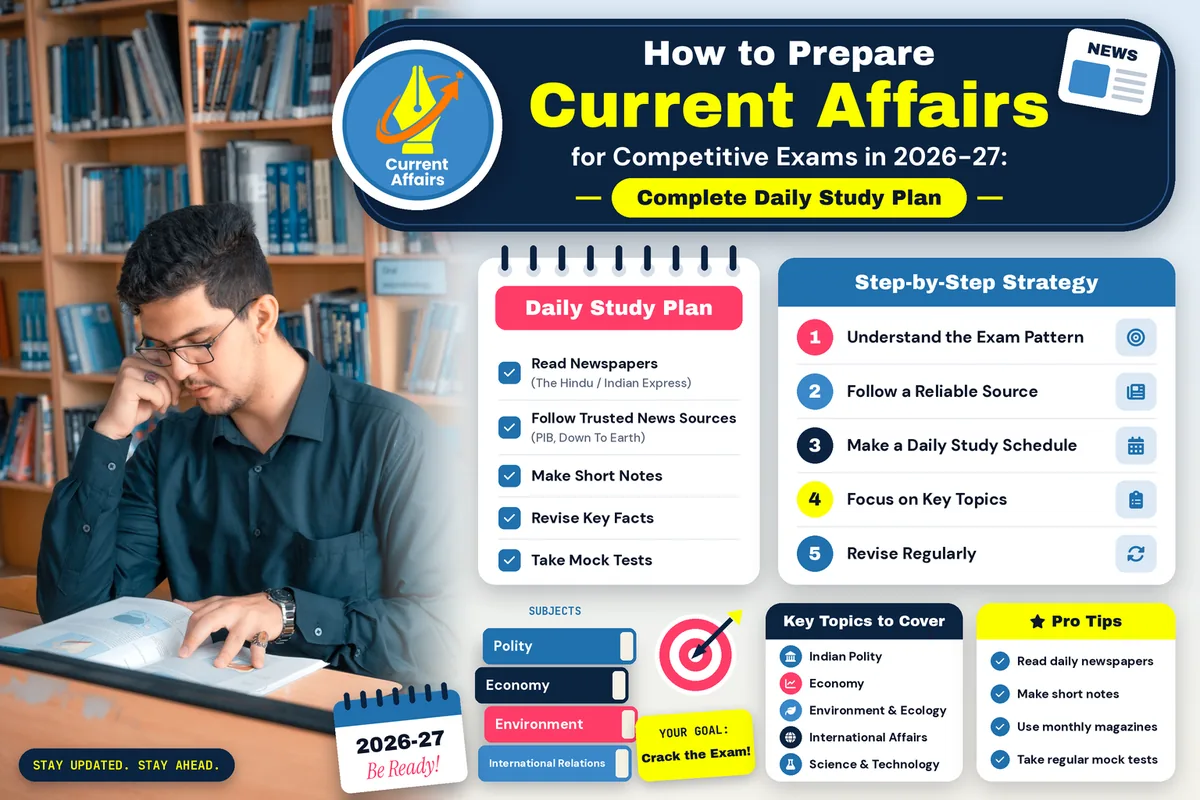
For government exam aspirants, they cover:
• National news and government policies
• International relations and global events
• Banking and financial awareness
• Economy and Union Budget updates
• Government schemes and initiatives
• Science and technology developments
• Sports news and tournaments
• Awards, honours and important appointments
• Environment and climate change
• Defence exercises and military developments
Studying current affairs improves general awareness, analytical thinking and knowledge of government policy, all of which are tested in competitive exams.
Which Competitive Exams Ask Current Affairs Questions?
Current affairs appear in UPSC Civil Services, State PSC exams, SSC CGL, SSC CHSL, IBPS PO, IBPS Clerk, SBI PO, SBI Clerk, RBI Grade B, RRB NTPC, RRB Group D and most other government recruitment exams. How they appear differs by exam, as the table below shows.
Exam | Where current affairs appear | Typical focus |
UPSC Civil Services | Prelims (GS Paper I) and Mains (GS papers, Essay, Interview) | Polity, economy, environment, international relations, science and technology |
SSC CGL / CHSL | Tier 1 General Awareness section (25 questions) | Awards, sports, schemes, important days, static GK |
IBPS PO / Clerk, SBI PO / Clerk | General / Economy / Banking Awareness, mainly in Mains | RBI, monetary policy, banking, finance, schemes |
RBI Grade B | General Awareness in Phase 1; Economic and Social Issues and Finance and Management in Phase 2 | Economy, banking regulation, policy |
RRB NTPC / Group D | General Awareness in CBT | Science, sports, awards, national events, schemes |
Exam patterns change. Always confirm the section-wise questions and marks in the latest official notification on the exam body's website (upsc.gov.in, ssc.gov.in, ibps.in, sbi.co.in, rbi.org.in, indianrailways.gov.in.
Why Are Current Affairs Important for Competitive Exams?
Current affairs are important because many government exams directly test awareness of recent national, international, economic, political and scientific developments, and they can decide your rank in sections where marks are easy to score. The main reasons:
They improve general awareness. Daily reading builds an understanding of what is happening in India and worldwide.
They score in General Awareness sections. SSC, Banking and Railway exams include general awareness and general knowledge questions.
They help you understand government schemes. Schemes, ministries and policies are frequently asked.
They strengthen banking awareness. IBPS, SBI and RBI aspirants should follow RBI announcements, monetary policy and economic updates.
They link to the UPSC and State PSC syllabus. Current events connect to polity, economy, geography, science and environment, and also support Mains answers and the Interview.
How to Prepare Current Affairs for Competitive Exams in 2026: 7 Steps
Follow these seven steps: (1) read daily, (2) make short notes, (3) practise MCQs, (4) follow monthly compilations, (5) focus on your exam, (6) solve PYQs, (7) revise regularly.
Step 1: How should I read daily current affairs?
Read 15-25 exam-relevant news items for 20-30 minutes every day, instead of reading every article online. Prioritise:
• National and international developments
• Government schemes
• Important appointments
• Banking and economic updates
• Science and technology
• Sports and awards
• Defence and security
• Environment and biodiversity
Skip crime, entertainment gossip and routine political commentary unless it links to a policy, law or institution.
Step 2: How do I make short current affairs notes?
For every important item, write the what, where, when, who and why in two to four lines. Note:
•What happened?
•Where did it happen?
•When did it happen?
•Which organisation or ministry was involved?
•Why is it important?
•What facts should you remember for the exam?
Sample note format for a government scheme:
Field | What to write |
Scheme name | Official name |
Ministry | Concerned ministry or department |
Objective | Main purpose in one line |
Beneficiaries | Target population |
Key facts | Launch date, budget, key features |
Sample note format for an appointment or award: Name, post or award, organisation, predecessor or previous winner, place or date, and one-line significance.
Keep notes short, organised and easy to revise. Notes you cannot revise in 30 seconds are too long.
Step 3: How many current affairs MCQs should I practise daily?
Practise 10-20 current affairs MCQs every day, and read the explanation even when your answer is correct.
Daily MCQs help you:
• Understand exam question patterns
• Identify weak areas
• Improve accuracy
• Remember facts through active recall
• Build confidence before the exam
Step 4: How do I use monthly current affairs?
Daily reading teaches individual events, while monthly revision connects them. At the end of every month:
• Revise national and international news
• Review government schemes
• Study banking and economic updates
• Revise awards and appointments
• Take a monthly current affairs quiz
• Create a separate list of high-priority topics
Step 5: How do I focus on my specific exam?
Match your study to the exam: policy and governance for UPSC, awards and sports for SSC, RBI and finance for Banking, and science and national events for Railways.
•UPSC: Indian polity and governance, international relations, economy and budget, environment and ecology, science and technology, government schemes.
•SSC CGL and CHSL: National and international events, awards and honours, sports, government schemes, important days, static GK.
• Banking (IBPS, SBI, RBI): RBI notifications, monetary policy, banking regulations, financial awareness, government financial schemes, economic developments.
•Railways (RRB NTPC, Group D): General awareness, science and technology, national events, sports and awards, government initiatives, important historical and geographical facts.
Step 6: How do previous-year question papers help?
PYQs show you which topics and question styles an exam repeats, so you can study what is actually asked. Practise papers from UPSC Civil Services, SSC CGL, SSC CHSL, IBPS PO, IBPS Clerk, SBI PO, SBI Clerk, RRB NTPC and RRB Group D. Attempt them within the time limit, review mistakes, and understand why an answer is correct instead of memorising it.
Step 7: How often should I revise current affairs?
Revise daily, weekly and monthly, and keep a list of every question you got wrong.
When | What to revise |
Daily | The important news you studied that day |
Weekly | The week's key topics and weekly quiz |
Monthly | All important monthly current affairs |
Before the exam | Short notes, MCQs, PYQs and your wrong-answer list |
Daily Current Affairs Study Timetable for Competitive Exam Aspirants
A consistent 60-90 minute routine works better than irregular long study sessions. Here is a sample timetable you can adjust:
Time | Activity | Duration |
6:00 AM - 6:30 AM | Read daily current affairs | 30 min |
6:30 AM - 7:00 AM | Prepare short notes | 30 min |
7:00 AM - 7:20 AM | Practise current affairs MCQs | 20 min |
Afternoon | Revise important facts | 15 min |
Evening | Practise GK and previous-year questions | 30 min |
Before sleeping | Review missed questions | 10 min |
Study plan by time left for your exam
Time left | What to do |
6+ months | Follow the full daily routine; build monthly notes |
3-6 months | Daily reading plus weekly and monthly revision; start PYQs |
1-3 months | Revise monthly compilations, take full-length mocks, focus on weak topics |
Last 2-4 weeks | Revise only short notes, wrong-answer list and last 3 months of news |
How Many Months of Current Affairs Should I Study?
Most aspirants revise the previous 6-12 months of current affairs, but the right period depends on the exam. Check the exam's notification date, syllabus and PYQ trends. UPSC Prelims questions often draw from the preceding year, while many banking and SSC questions focus on the last 6 months. Treat these as starting points and adjust using the PYQs of your target exam.
Common Mistakes to Avoid
• Reading too many sources. Pick one or two reliable sources and follow them consistently.
• Reading without testing. Reading feels productive, but MCQs reveal what you actually remember.
• Ignoring explanations. Correct guesses are not knowledge.
• Skipping revision. Unrevised notes are forgotten within weeks.
• Memorising without context. Understand why an event matters, which makes facts easier to recall.
• Ignoring static GK. Many current affairs questions link to static facts such as headquarters, ministries, capitals and constitutional bodies.
• Not tracking mistakes. Keep a wrong-answer list and revisit it weekly.
Sample Current Affairs MCQs (Practice Format)
These are format examples to show how questions are framed. Always verify facts for the latest developments.
Q1. Which institution formulates India's monetary policy?
(A) Ministry of Finance
(B) Monetary Policy Committee of the RBI
(C) NITI Aayog (D) SEBI
Answer:
Q2. Which body publishes the Economic Survey ahead of the Union Budget?
(A) NITI Aayog
(B) RBI
(C) Department of Economic Affairs, Ministry of Finance
(D) Finance Commission
Answer:
Q3. A question on an award, appointment or scheme usually asks for:
(A) Only the name
(B) Name, organisation, place and year
(C) Only the date
(D) Only the amount
Answer:
Best Way to Prepare Current Affairs Online
The best online platform gives daily updates, topic-wise MCQs with explanations, quizzes, PYQs and performance tracking in one place. Look for:
• Daily current affairs updates
• National and international news summaries
• Topic-wise multiple-choice questions
• Answer explanations
• Daily GK quizzes
• Previous-year question papers
• Performance tracking
• English and Hindi learning support
Choosing one reliable source and following it consistently reduces the confusion caused by too many platforms.
Trusted official sources for verification
Source | Best for |
PIB (pib.gov.in) | Government press releases, schemes, cabinet decisions |
RBI (rbi.org.in) | Monetary policy, banking notifications |
Union Budget (indiabudget.gov.in) | Budget and Economic Survey |
UPSC / SSC / IBPS official sites | Syllabus, notifications, exam pattern |
Ministry websites | Scheme guidelines and data |
What Is Current Affairs Desk by JobSafal?
Current Affairs Desk by JobSafal is an online platform for competitive exam aspirants that provides daily current affairs, MCQs with explanations, daily quizzes, previous-year question papers and performance tracking in English and Hindi. It is designed for UPSC, SSC, Banking, Railway and other government exams.
Key features:
1. Daily Current Affairs Updates: 15-25 curated articles every day with concise summaries and exam-focused analysis.
2. Current Affairs MCQs with Explanations: Questions linked to individual news articles, with written explanations.
3. Daily Current Affairs Quiz: A fresh daily quiz with performance review.
4. Previous Year Question Papers: Timed PYQs organised by exam and year.
5. English and Hindi Content: Articles, questions and explanations in both languages.
6. Performance Tracking: Quiz attempts, accuracy, progress and missed questions, so you know what to revise.
Who it is for: aspirants of SSC CGL, SSC CHSL, IBPS PO, IBPS Clerk, SBI PO, SBI Clerk, RBI Grade B, UPSC, State PSC, RRB NTPC and RRB Group D.
Start your preparation: visit Current Affairs Desk to read daily current affairs, take quizzes and practise MCQs.
Frequently Asked Questions (FAQs)
How can I prepare current affairs for competitive exams?
Read exam-focused news daily, prepare short notes, practise 10-20 MCQs, revise weekly and monthly, and solve previous-year question papers. Follow one reliable source consistently.
How many months of current affairs should I study for competitive exams?
Many aspirants revise the previous 6-12 months. The exact period depends on the exam, so check the syllabus, notification and previous-year trends.
How many hours a day should I study current affairs?
About 60-90 minutes a day is enough for most aspirants: 20-30 minutes reading, 20-30 minutes notes, 15-20 minutes MCQs and 10-15 minutes revision.
Which topics are important in current affairs?
Government schemes, national news, international relations, banking, economy, sports, awards, appointments, science and technology, environment, defence and important days.
Is daily current affairs preparation necessary?
Yes. Daily preparation keeps you updated, avoids last-minute pressure, and makes monthly revision much easier.
Are current affairs important for SSC and Banking exams?
Yes. SSC exams include a General Awareness section, and banking exams test banking and financial awareness, often in the Mains stage. Pattern details change, so confirm in the latest notification.
Is current affairs enough to clear the General Awareness section?
Not always. Combine current affairs with static GK (polity, geography, history, science, important days, ministries and organisations), since many questions link the two.
What is the best way to remember current affairs?
Use active recall: write short notes, solve MCQs, revise at fixed intervals (daily, weekly, monthly) and keep a list of questions you answered wrongly.
How can I improve my current affairs GK?
Read daily current affairs, practise GK questions, take quizzes, prepare short notes and revisit incorrect answers regularly.
Is a monthly current affairs PDF enough?
A monthly PDF is useful for revision, but daily reading and MCQ practice help you remember facts better. Use the PDF to revise and not as your only source.
Do I need to read newspapers for current affairs?
For UPSC and State PSC, a quality newspaper helps build depth. For SSC, Banking and Railways, a daily exam-focused current affairs summary is often enough.
How can I practise current affairs questions online?
Use daily quizzes, topic-wise MCQs with explanations and PYQs on exam preparation platforms.
Where can I read daily current affairs in English and Hindi?
Current Affairs Desk by JobSafal provides daily current affairs articles, MCQs, quizzes and explanations in English and Hindi.
Conclusion
Preparing current affairs does not have to be complicated. Follow a structured routine, focus on exam-relevant information, practise questions regularly and revise consistently.
Read daily, practise regularly and revise consistently.
Visit Current Affairs Desk to make your daily current affairs preparation more organised and effective.
Tags: Current Affairs 2026, Daily Current Affairs, Current Affairs November 2026, Current Affairs for Competitive Exams, UPSC Current Affairs, SSC CGL Preparation, SSC CHSL Preparation, IBPS PO Preparation, IBPS Clerk Preparation, SBI PO Preparation, Banking Awareness, Railway Exam Preparation, RRB NTPC Preparation, GK Questions and Answers, Current Affairs MCQs, Daily Current Affairs Quiz, Monthly Current Affairs, Previous Year Question Papers, Current Affairs Study Plan, General Awareness.
Comments · No comments yet